
Repeating the Gorge
Taoism in Perthshire

I’m in Perthshire, Scotland. Ostensibly, I’m on leave, but on holiday, if you’re lucky, the work you most need to do finds a way to catch up with you. Yesterday, my main job was walking up, around, and down The Birks of Aberfeldy.
‘Birks’ is Scots for birch trees, and to the uninitiated, the place offers a modest forest hill walk of about an hour with good views of an excitable stream down below. There are no guardrails; it’s very steep in places, so it is ill-advised for people with vertigo, wayward pets, or dangerously curious children.
The birks surround a gorge, with running water flowing from a gap in the rock, through two steep slopes, connected by a wooden bridge. A gorge is not a canyon or a ravine or even a glen - it’s distinctive for the combination of sloping heights on either side and flowing water bursting through whatever is left of the middle. We can think of it as a huge three-dimensional horseshoe with a crevice allowing water to flow and then splash around in the middle on its way out. The same word in French - gorge - means throat, and the walk is like circumnavigating one of Earth’s many throats, with all that this means for speech, breath, and nourishment. In a sense, a gorge is how water finds its voice.
We speak of places having a spirit of their own, and sometimes that is literally the case. This place was The Den of Moness, and before that, it took its name from a creature said to live in these very falls — the Peallaidh, a shaggy water-spirit of Gaelic tradition, who haunted the Upper Falls where the bridge now lies, and came out at night to trouble the townspeople. I like the fact that the peallaidh was not considered evil, just restless, a little troublesome, and present.
More recently, the spirit of the place stems from Scotland’s national poet.
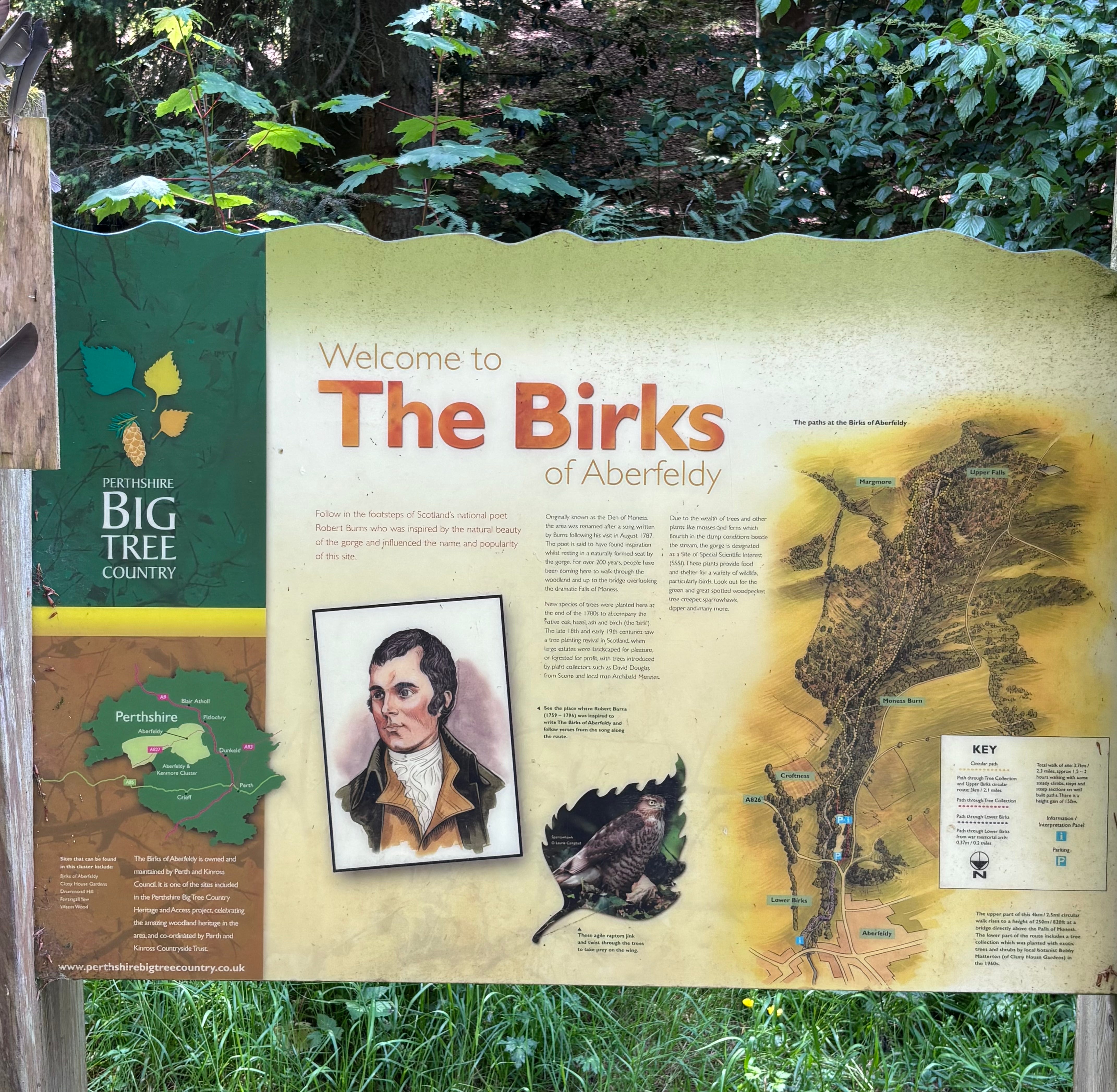
Robert Burns was inspired by the place to compose a poem in 1787, and it reads as a courtship, giddy and wistful in spirit, a repetitive incantation that lends itself to song. It is by no means my favourite Burns poem, but the opening and closing lines inspired the famous lyrics in Wild Mountain Thyme: “Will ye go, lassie, go?” and I was happy to see verse four carved into wood, overlooking the gorge.
The braes ascend like lofty wa's,
The foaming stream deep-roaring fa's,
O'erhung wi' fragrant spreading shaws-
The birks of Aberfeldy.
I did the same walk just under a year ago, in a particularly difficult phase of life. My mental health is robust, but we all face unexpected events, and everyone’s resilience is finite. I remember the last time I walked this path, how hard it was to escape involuntary rumination long enough to attend to the scenery (and poetry) around me. It was like I could see it, and wanted to escape myself so that I could feel it, but the trunks and leaves and aquatic acoustics and dappled sunlight - none of that was really available to me. I was, alas, my thoughts, and they felt heavy, almost literally. I could only lift myself out from under them for a few seconds at a time, for brief and necessary conversations with the world beyond.
**
Yesterday was very different. I felt light and energetic, and part of the vitality I had entered into. And as I walked and looked down, I noticed something delightful. Here I am, I thought, repeating the gorge.

I knew this expression from Hexagram 29 of the I Ching, the ancient oracle of changes. The I Ching is one of the oldest books in the world, but it was also described by Alan Watts, quite elegantly, as “a 64-sided coin toss”. If you seek the I Ching’s advice, your main symbol will be one of 64 hexagrams, one of 64 different sequences of ‘yin’ and ‘yang’ lines that represent a context or predicament that speaks to where you are in your life.
Hexagram 29 is translated in some places as ‘repeating the gorge’, and that’s partly because it is two identical triagrams on top of each other, both of which represent water. It is not an auspicious symbol, and has even been translated as ‘the abysmal’. It is about enduring hardship, a repeated danger we have to confront, but it’s also about being water-like in response, patient, adaptable, and persistent, eventually finding a way.
I have not written much about the I CHING, and I haven’t used it for a long time, but I am, in a sense, a believer. I don’t quite know how or why it works, but when you approach the oracle with an open mind and ask for its guidance on any given matter at hand, it often feels like it speaks directly to the heart of the matter, even if the mode of communication is imagistic, metaphoric and oblique.
There is a lot of hermeneutic hedonism available in offering interpretations of the hexagrams and their commentaries. It is fun to decipher depth, but it can be a mistake to dig for exclusive meanings. The gorge is definitely dangerous, but it can also be seen as the unconscious, a symbol of the scarier parts of ourselves that we have not integrated. And repetition is something we tend to eschew in this neophilic world, where novelty leads the way and shapes the economy. But repetition is the practice required to get to the heart of any skill. And then there is the injunction to “be like water” that informs the Taoist philosophy of ‘wu-wei’, which is a kind of discerning effortlessness.
Hexagram 29 can therefore be seen as a symbol holding the tension between the Confucian and Taoist strains of Chinese thought. On the one hand, trust in authority, know the classics, practice, and follow the rules. On the other hand, try not to try, be at one with all that is happening, and go with the flow. I am reminded of chapter 78 of another Chinese classic, the Tao Te Ching, translated roughly as:
The Soft overcomes the hard. The gentle overcomes the rigid. Everyone knows this to be true. But few can put it into practice.
I am not sure, then, quite what repeating the gorge means to me, but I notice how profound it can be to find yourself back in the same place, and thereby know yourself as someone who changes over time.
The birks are probably as they were when Burns wrote his poem over 200 years ago, and they will still be there when I’m gone. In the meantime, the birch trees will grow, bend, and fall, the water will continue to flow, and people will come back and walk around, repeating the gorge.
I hope the writing of the the gorge was as easy on the spirit in a Wei Wu Wei, way as the reading ... It is delicious and took me to all sorts of visceral places ... I've looked into a few gorges from unsafe footings, and cast the "64 sided coin toss" and was delighted it was Watts your writing conveys the flow of the Tao as the something like Rumi's Field out beyond, between, behind and before the words hinting at the first line of the Tao de Ching"
I will savour the content and pointing and sit with it to see what resonates within
Thank You Johnathon 🙏💙🙏
I’ve been studying the Iching for a little while as a part of examining Jung. Like many of these tools, they are generative if you use them in the way intended.