

MOTH is a bio-socio-legal movement trying to shift our understanding of the world in thought, word, and deed, but I can’t speak of anything moth-related in good faith without first sharing Norm McDonald’s rendition of a joke about the moth that went to see a podiatrist. It’s essentially a 20-second tease, but when the joke was extended on an impromptu basis on national television, it became one for the ages.
You don’t have to watch it, but there are worse ways to spend five minutes.
Why moths? Well, everyone loves butterflies, but moths predate butterflies by about 300 million years, and they make up about 90% of the Lepidoptera order. There are only around 20,000 species of butterflies, but at least ten times the number of species of moths. They produce silk, and some of them have ears on their wings, so let’s hear it for moths.
"The significance of the moth is change. Caterpillar into chrysalis, or pupa, and from thence into beauty. Our Billy wants to change, too."
Who said that? Hannibal Lecter (Anthony Hopkins), no less, in The Silence of the Lambs.
“Like a moth to a flame. Only I am to blame…”
Madonna, no less, said that, in her track “To Have, not to Hold”, in her album, Ray of Light.
I wrote these words before school drop off, and on the way home, the following comment appeared on my Substack Notes timeline:
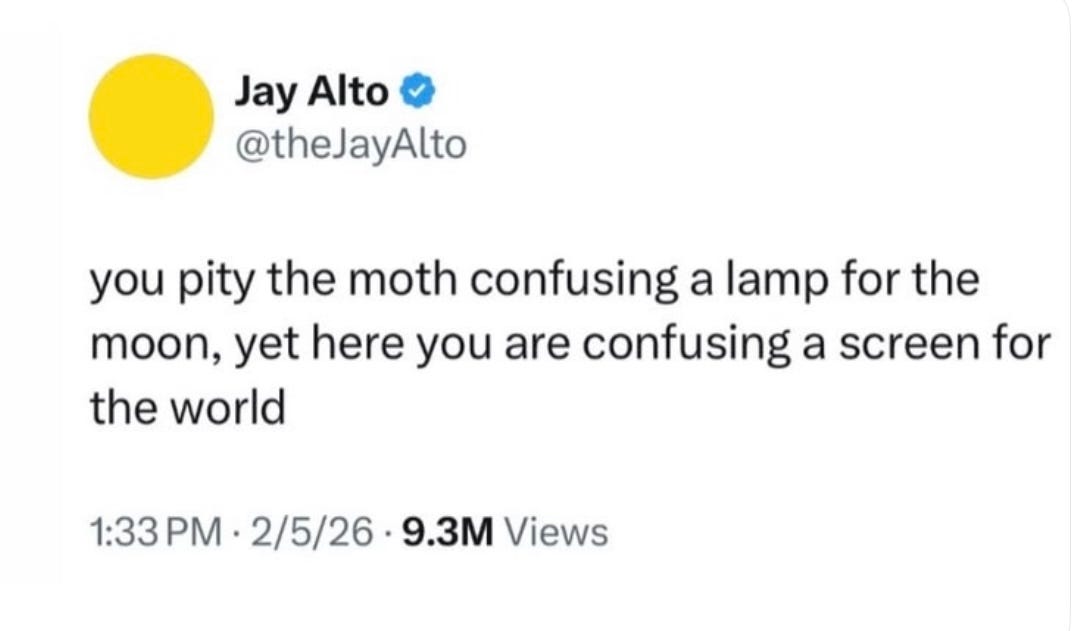
Here you are, confusing a screen for the world. But be kind to yourself, because the screen is part of the world, and a portal into it. And there is a certain amount of philosophical eros in both cases, because we are drawn to the screen by an all-too-human desire for connection, just as the moth is drawn to the flame by a pure kamikaze desire to return to the source of all things - the eternal flame, the unforgettable fire; even if what that means is that they become anti-heros, singed by the all-too-forgettable fire known as the light bulb, joining the fallen legion of moth corpses in millions of unsuspecting lamp shades all over the world.
**
So much for moths. I spent most of Thursday and Saturday of last week at a festival of ideas event put on at LSE in London, by a project from NYU called ‘MOTH’.
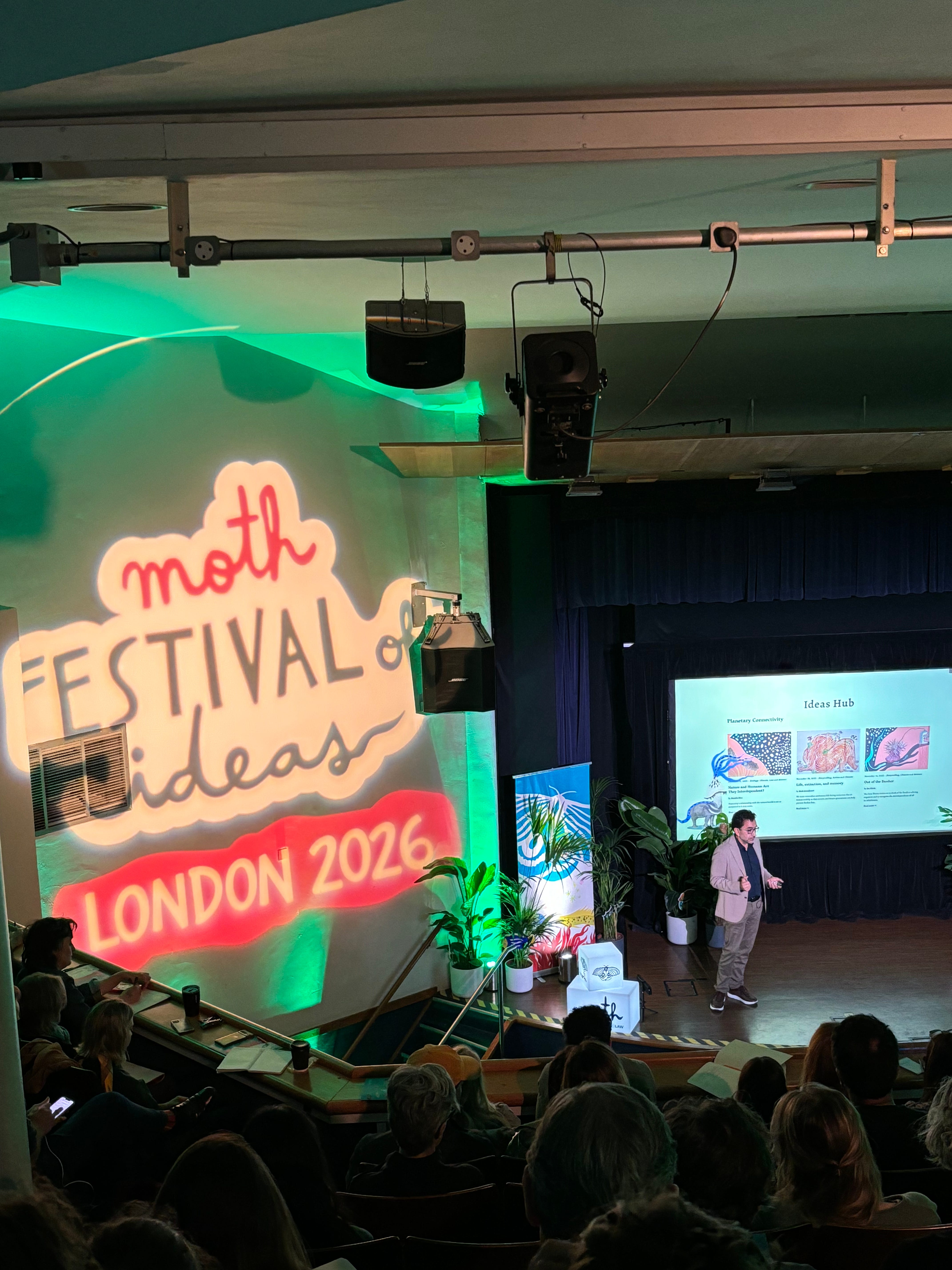
The word MOTH stands (slightly awkwardly) for More than Human Rights. I came to know the group when I was invited to a related initiative called FORGE - Future of Rights and Governance, also at New York University’s Law School, in 2023, to talk about The Inner Life of the Future.
FORGE, MOTH, Potato, Potatto. The names don’t have to match perfectly, and I am more interested in the Vedic principle of Nama-Rupa, that things take on the form of their names. At the level of nama-rupa, the name MOTH is a good call, because, like the moth, it is a transformative venture, and I don’t mean that in the lazy-honorific-rhetorical sense of transformative, but in the 'underlying form we need to transcend’ sense.
The Director of MOTH is a Colombian legal scholar based at NYU called Cesar Rodriguez-Garavito (on stage introducing the event in the image above). Back in 2020, Cesar was kind enough to publish my open letter to the human rights movement in Open Global Rights, to take the trouble to translate it into Spanish, and invite me to New York a few years later, so I would be a big fan, even if his work wasn’t otherwise very impressive. Cesar is a serious scholar, and recently produced the main book on Climate litigation called Climate on Trial, but he is not merely an academic. For instance, he features in Robert Macfarlane’s celebrated new book, Is a River Alive?, where he is described on page 47/48 as being like the warrior-priest in Rogue One who is ‘one with the force, and the force is with him’ - the joke felt apt. In the same source, Cesar is quoted as saying:
We are living in an ongoing emergency. I am tired of fighting the long defeat. I want hope. I thrive on it.
I am tired of fighting the long defeat, too.
The idea of giving rights to nature can seem strange at first blush, and question- begging. What is ‘nature’? Aren’t we part of nature? Isn’t it ridiculous to extend rights to everything - where will it end?
However, it seems less strange when you consider that the bedrock of most societies is still the rule of law, that rights give access to the law, and that all kinds of entities have legal protection that humans speak on behalf of. Listed buildings have rights of sorts - you can’t just knock down the walls inside even if you own them - and corporations are treated as persons with rights; and many who are unable to represent or speak for themselves, including young children, people in comatose states, and the mentally handicapped, have rights. We don’t tend to think it’s strange in any of these cases for people to recognise these rights and, with due care and consideration, speak on their behalf. The question is why some find it a stretch to apply the same logic to rivers, lakes, forests, or other species. Surely they have legitimate interests too that we can imagine and represent?
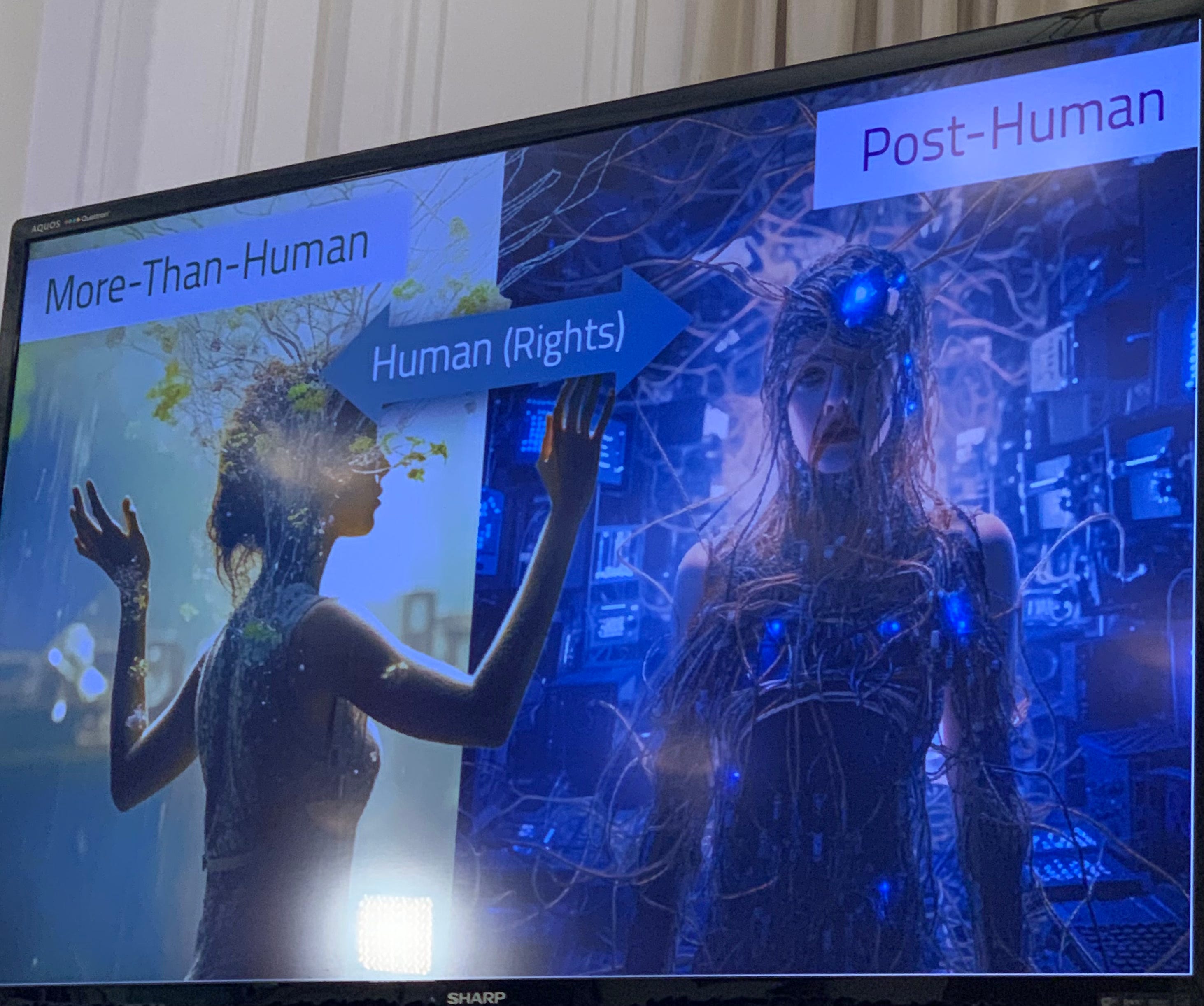
But the rights of nature endeavour might be too zoomed in as a starting point to grasp what is at stake here. A better frame comes from FORGE in 2023, where Cesar gave a short lecture, and I took this photo of his slide highlighting two major visions of the future - The Post-Human and The More-Than-Human - which are superficially similar, but carry radically different views of the world and visions of the good.
They say that technology owes ecology an apology.
It’s not that funny, but we are in a phase of history where the operative battle is technology v ecology all over again. However, it is not one against the other, it’s more like who is in charge, and there is political weight and metaphysical depth to the distinction. While some place their faith in humans making wise use of technology to serve and protect nature as the basis of the sacredness of life as a whole on our only viable habitat, others see humans serving technology by making use of nature to create the possibility of alternative futures on other habitats (i.e. planets).
Now, it’s never that simple, of course. There is solar punk for a start, and then digital naturalism, and all kinds of ways in which technology and ecology intertwine for the greater good. However, I do think, if you observe closely, that there is a very significant distinction in play.
Some veer to technology serving ecology, while others veer to ecology serving technology, and the question of which of those points of emphasis is politically and economically empowered will make all the difference in the world, and to the world.
MOTH is actually technophilic, and appears to see a major role for developments in science and technology in clarifying the interests of the more-than-human world. But that’s very different from burning fossil fuels to power AI data centres to attempt to create conscious machines.
Which is why metaphysics matters. I don’t have the capacity today to do this point justice today, but what is underway is essentially a battle of what Mesoamericans call cosmovisions.
On the one hand, you have the post-humanists desperately trying to summon life through conscious AI or superintelligence, as if beckoning Ahriman in their bid for power. On the other hand, you have a new animism morphing into a kind of enchanted panentheism, with a strong emphasis on ancestors acting through animals and mammals, and the role of other ‘beings’, all of whom are part of the more-than-human world, the perennial family of Mother Earth.
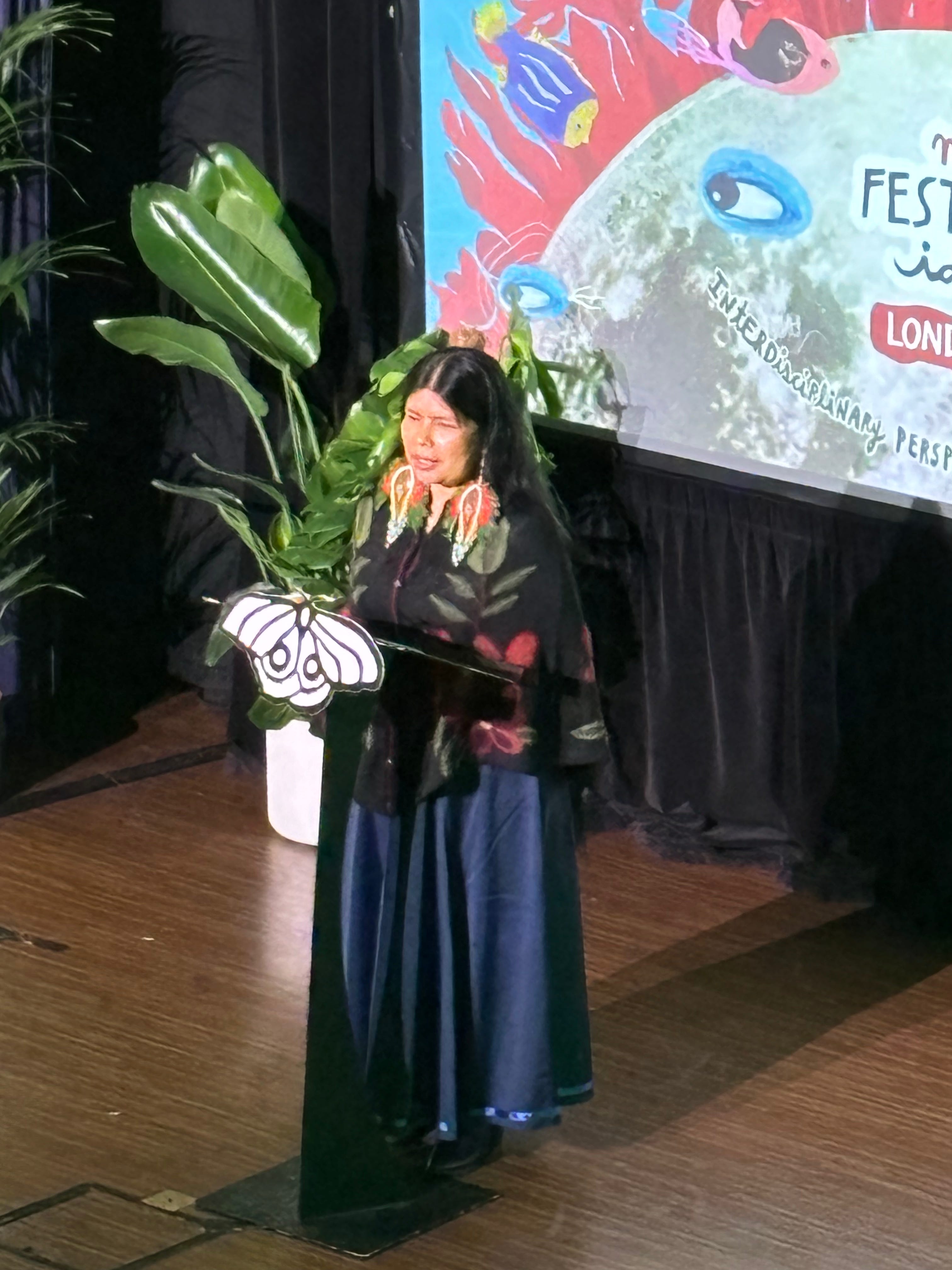
For example, last Thursday, Patricia Gualinga from Ecuador (image below) spoke about her indigenous understanding of other beings that live within nature and protect it. She also shared that this is largely pan-indigenous and not unique to the Sarayuku people. One of her lines (translated from Spanish) was “They are in places where humans are not.” She did not say ‘the imaginal realm’, but I could not help but think of that.
The Rights of Nature question is interesting in its own right, and part of a growing appreciation I feel for the spirit of the law. As Roberto Mangabeira Unger puts it, we can imagine that the law is already here, waiting to be found within reality:
The search for this latent and living law—not the law of prescriptive rules or of bureaucratic policies, but the elementary code of human interaction—has been the staple of the lawyer’s art wherever this art was practiced with the most depth and skill. What united the great Islamic ‘ulama’, the Roman jurisconsults, and the English common lawyers was the sense they shared that the law, rather than being made chiefly by judges and princes, was already present in society itself. Throughout history there has been a bond between the legal profession and the search for an order inherent in social life. The existence of this bond suggests that the lawyer’s insight, which preceded the advent of the legal order, can survive its decline.
I see the rights of nature as part of that jurisprudential search for what is real. And I can also see why the rights of nature challenge has become a game of choice in the technocratic arena, where we all have to find and create whatever power we can to fight the good fight as we see it.
But what is really going on seems like a deeper battle for reality. To recognise a river as being alive, with a legitimate interest in not being polluted or impeded; to recognise a forest as a kind of organism inhabited by natural and supranatural beings; to recognise a whale as a tribal ancestor - this is, as they say, deep sh*t.
If you’ll forgive a Netflix reference, I was reminded of the killing of the moon spirit, destroying the balance of the world in the story of the Avatar. That may be fiction, but it’s not clear if what it depicts is fantasy. What Patricia Gualinga is saying, and what many other indigenous leaders are saying, is that there really are spirits and beings that protect nature, and if we destroy them, nature will not recover. This is not metaphorical or figurative language. They really mean it, and I think we would be wise to take them seriously, even if we don’t necessarily have to take them literally.
If the notion that nature is imbued with spirits seems indulgent, there is surely no denying that ancestors live on within us at some level. And yet the more-than-human-rights movement appears to push that point, with some suggesting that ancestors appear and act today in agentic ways in non-human forms, including as whales.
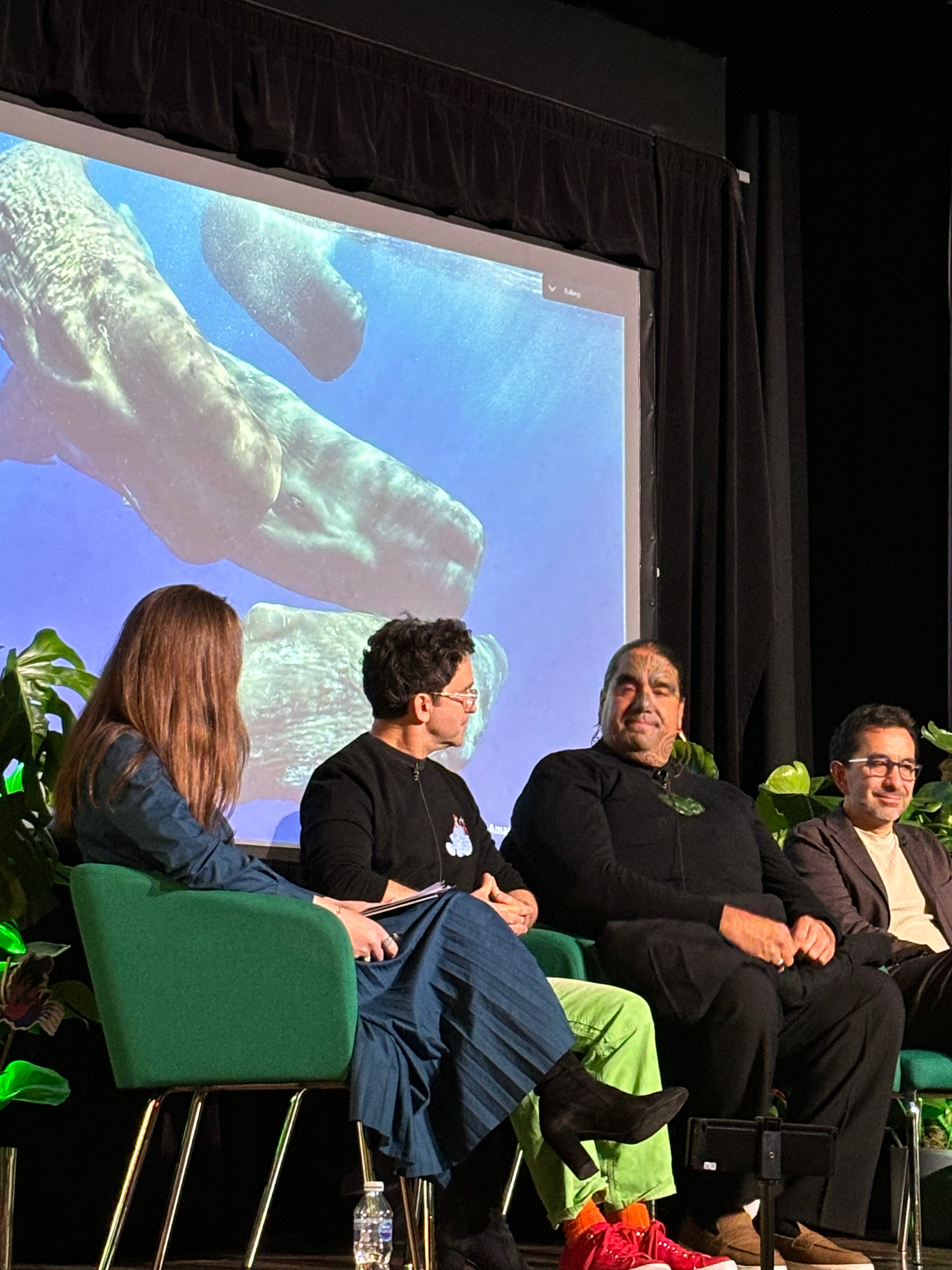
I have called this post the metaphysics of whales because the session that touched me most on the Saturday (image above) was about whales. This was a great session in general, and it reminded me of the film Whale Rider, but it was altogether more serious. There is now a science of whale sounds which can be analysed with AI to indicate something quite close to discernible whale speech, to the point where you can tell from a sound with a high degree of accuracy, when they are about to dive from the surface to depths. There are also campaigns underway, many of them successful, to change shipping lanes so that whales are not hit or disturbed. You could even say the whales were in the room. The quiet star was a tribal leader, Aperahama Edwards, from the Ngati Wai tribe in New Zealand. Cesar remarked:
The cadence of Aperahama’s speech is the cadence of the ocean itself.
I knew exactly what he meant. Wherever Aperahama is speaking from, I have never felt anything quite like it - deep, careful, resonant, heartfelt, slow but riveting, like he makes himself available for a transmission, that he only says what he feels is his to say, and that he knows when to stop. He said that he felt he had a duty to speak for those who could not speak for themselves, and that included the whales. He shared several precise terms from his language, which I believe is Te Reo Māori, and when he spoke in English, I could feel the duty to communicate, the blessing of speech, and the gravity of purpose it confers.
Later, I was lucky to sit next to Aperahama at dinner and to ask some further questions. I was left in no doubt that he does think of the whales as tribal ancestors and acts accordingly on their behalf. As a case in point, he said that in his tradition, if a whale is washed ashore, this is generally considered a gift from the ancestors. Since it is so difficult to get the whales back in the water, the custom is just to ensure that every single part of the whale is put to good use. He remarked that straining to return the whale to the water feels like refusing a gift, and that traditionally this effort has made his people feel uncomfortable. And yet he also said that today, pragmatism and a love for the whales mean that they do support efforts to get the whales back in the water and are glad when it works out. But I was struck by the sense of ethical and spiritual struggle that was clearly heartfelt, and what it means for his understanding of the metaphysics of whales.
I may have more to say about all this in due course, but for now, I just wanted to mark that it was a pleasure to be at MOTH, where legal activism is the socially acceptable face of metaphysical transgression, and the spirit of resistance is strong.
This is what I wanted to read this morning. Thank you.
Speaking of Moths, I saw Rebecca Solnit speak on Sunday about her new book, The Beginning Comes After the End, and she said we are in the "goop" phase of a chrysalis. The caterpillar begins to "liquify" and is no longer recognizable as a caterpillar, but neither is it yet a moth.
And an aside on all your notes about "anarchism," an astrologer I read here (don't judge) likens the kind of "stateless" form of arising consensus that he believes we are moving towards as a "murmuration." That was the first time that I could feel in my body what real "anarchy" might be like. Birds and moths and whales...
Thank you for this wide-open exploration of moths, whales, and the liminal realm...
Years ago I had a dream about a whale beaching itself on a lake in Northern Ontario. I was so intrigued (in the dream) about this remarkable event that I raced up to the cabin to get my camera to take a picture and prove the whale, and his partner, were actually there. However, when I returned, the two of them were gone. Waking from the dream I was heart-sick at my habitual, egoic reaction, so I settled into a deep meditation, opened my heart and asked for forgiveness. What evolved was a most remarkable 'transmission' from the whale that left me with an even deeper respect for their wisdom and their role at this time.
Here is some of what the whale conveyed to me: "There is a deep and painful aching in the oceans - an amniotic screeching within the watery womb of the planet. it must be heard and released. You are one... (there are many others too) who has been tuned to bear this awful birth, a birth of such agonizing pain and unknown consequence."
At this point, I broke down weeping... The whale waited for me to regain my calm.
He continued: "We are not asking to be saved. That time has passed. We present ourselves to you in a pledge; an invitation to work with you in creating a new way, one where the hearts and minds are in complete communion with humanity. We need you, and you need us.
"The first step is simple: be present with us. Open and listen... beyond the grief, beyond the shame. Receive us as kin with information you can attain from none other. Linger with us, for our speech works in your cells in ways you only have a glimmer of remembrance... Do not dismiss what you feel in these rarified encounters, for it is the beginning of a new language between us. We need your hearts and your brains; you need our ways of knowing."