

Life does not cease to be funny when people die any more than it ceases to be serious when people laugh.
- George Bernard Shaw
There are many things about British politics that I don’t like,1 but there is one thing that I love, and I hope it never changes. That’s the moment of the declaration of counted votes where all candidates are briefly equal and lined up together, including those - especially those!- who are standing mostly for fun. I think of this spectacle as ‘the equality of absurdity’, and it is one of the few things these days that makes me proud to be British.
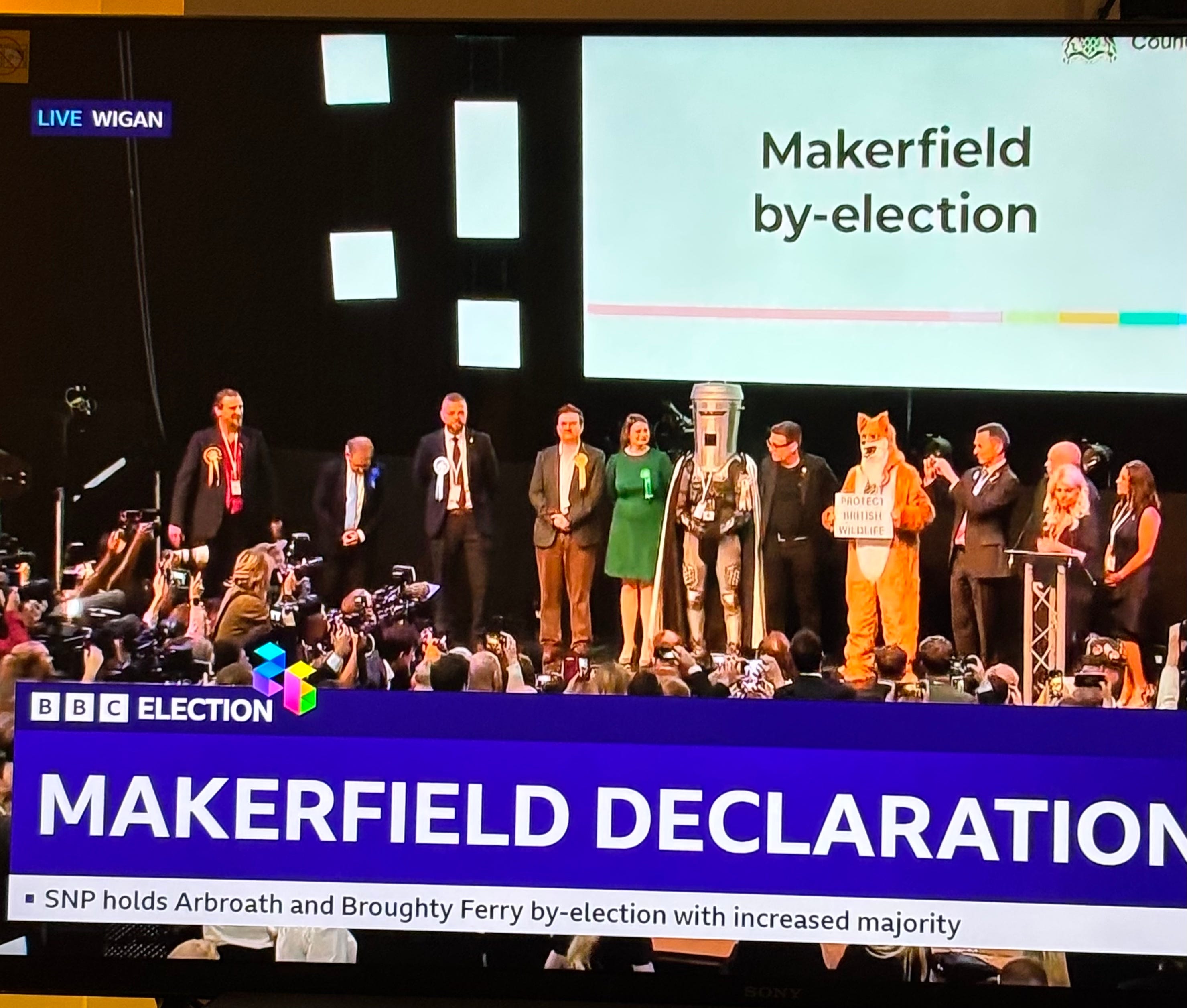
Last night, the person who, in all probability, will be the UK’s next Prime Minister later this year, Andy Burnham, was elected. I managed to sleep 10 pm to 2 am and woke myself up to watch the results come in. Burnham is a kind of everyman at first blush, and an unlikely hero, but he is perhaps the only senior Labour party figure apparently capable of carrying a large portion of the party’s traditional working class vote, while also attracting relatively young, metropolitan and progressive voters.
This result was significant political news because it changed the narrative that Reform - a relatively new party led by Nigel Farage that teeters between centre-right respectability and proto-fascist and sexist agendas- would inevitably win the next General Election. Moreover, this by-election happened expressly to give Burnham the chance to return to Westminster so that he could potentially challenge Keir Starmer as Leader of the Labour Party, and probably win.
However, the highlight of last night was, in my view, the fact that at the moment of the declaration, the man of the moment - Andy Burnham - was flanked by “Count Binface” (who was later interviewed by Sky News, and is hilarious) and a fox 🦊. (Slightly out of shot was the Monster Raving Loony Party candidate, representing a registered political party that has campaigned in the past for things like specially designated road crossings for hedgehogs 🦔, and introducing A Ministry of Clarity “to ensure only the clearest clarity is made clear, and the unclear clarity is cleared out”…)
Clearly(!) those wearing the costumes are more tangibly absurd, but the political satire is serious in its own way. The carnivalesque candidates are emblematic of the fact that we have not succumbed to authoritarian answers and remain free to live our questions. The subversive humour says we are, despite everything, a democratic culture. The humour is also existential because the absurd costumes liberate what would otherwise be an earnest moment, and with the earnest political spectacle undermined, the question becomes what we think we’re all doing, not just politically, but in life in general.
And are we not all wearing costumes of some kind? Do politicians not all seem, as Sting once put it, like game show hosts? Elections are a performance in democratic theatre, and everyone on stage is acting, playing a part. This reflection reminds me of that moment in the film Donnie Darko where Donnie says, “Why are you wearing that stupid bunny suit? And the reply is: “Why are you wearing that stupid man suit?”
Milan Kundera reflects on the politics of humour in various places, and though the connection is oblique, in an interview with Philip Roth in the New York Times, I see a link to the spirit of questioning:
A novel does not assert anything; a novel searches and poses questions. I don’t know whether my nation will perish and I don’t know which of my characters is right. I invent stories, confront one with another, and by this means I ask questions. The stupidity of people comes from having an answer for everything. The wisdom of the novel comes from having a question for everything... The novelist teaches the reader to comprehend the world as a question. There is wisdom and tolerance in that attitude. In a world built on sacrosanct certainties the novel is dead. The totalitarian world, whether founded on Marx, Islam or anything else, is a world of answers rather than questions. There, the novel has no place.
A joke is essentially a question, a way to suggest that what seemed closed can be opened; it unsettles, destabilises, refuses to conform - which is precisely why it’s dangerous to power. Here, I see a connection between the emphasis on fallibility and falsifiability in the open society theorising of Karl Popper and others - in theory what makes open societies out-compete authoritarian regimes is that the best ideas are out in the open and constantly tested and therefore improved, rather than a set of answers being imposed on the population and reaffirmed even when they fail.
Moreover, a freshness of direct experience arises when we feel we have just stepped out of a constraining structure of some kind. Humour has its own kind of epistemology, therefore, and the heart of it is an insistence that the map is not the territory; what we know when we laugh is that we are free to shape the territory in ways that subvert any map.
Coming back to the line-up before the results are announced - to Count Binface and Mr Fox - it’s the levity before the gravity that I love, and the levity *because* of the gravity.
Both levity and gravity clearly matter, and they need each other. and in some ways create each other. Humour is fundamentally about a sense of proportion and the subversion of pattern recognition, but it needs to have something to be disproportionate about, and there needs to be conventional patterns to subvert.
In this co-arising of power and humour, I am reminded of a song lyric by Don McLean in his classic, American Pie:
“And while the king was looking down, the jester stole his thorny crown. The courtroom was adjourned. No verdict was returned.”
May our politics be better. And may we take our own political agency seriously.
Yet may we also always be able to laugh at our all-too-human efforts.
And may politicians share their stage with those who feel the call to remind us of the bigger picture we all share: the glorious absurdity of the human predicament.
For instance, our voting system is designed for two parties, and millions of votes are effectively wasted when there are more than five parties; only one can win in each place at a time, and none of the non-winning votes contributes to a mandate. And we have a mostly shallow mainstream media that always seems to be trying to impress itself. There is also an ambient anti-intellectualism that feigns interest in ideas, but was, for instance, too scared to ask out loud what democracy might mean, even when every second political conversation was about the democratic legitimacy, or otherwise, of leaving the European Union in the way we did. There is also a failure to reckon with our colonial past - more Brits feel pride than shame about the Empire. And as far as I can tell, we are mostly a reality-avoidant culture. There is little appetite for envisioning transformed futures.
Not sure. Humour and satire might have been subversive and an important force against authoritarian power but in an age of mockery and ridicule they actually help perpetuates power (“keep it light, dude”). Boris as the ultimate clown, I guess. Comedy, in that sense, is not unrelated to constant critique (Arpad Szakolczai makes this point, I think). Dissent and the piss-take are, as Thomas Frank said back in 1994, just the official style of the culture of late capitalism.
At the cultural level I think it's one of the myths British people like to tell themselves (a fabled eccentricity). I guess every culture has them (for Americans it's rugged individualism).