
The Epistemic Orchestra
A book launch, embodied cognition, and Gandhi's second sandal.

On Monday, I attended the book launch of Bodies of Learning by Guy Claxton and Emily Poel.
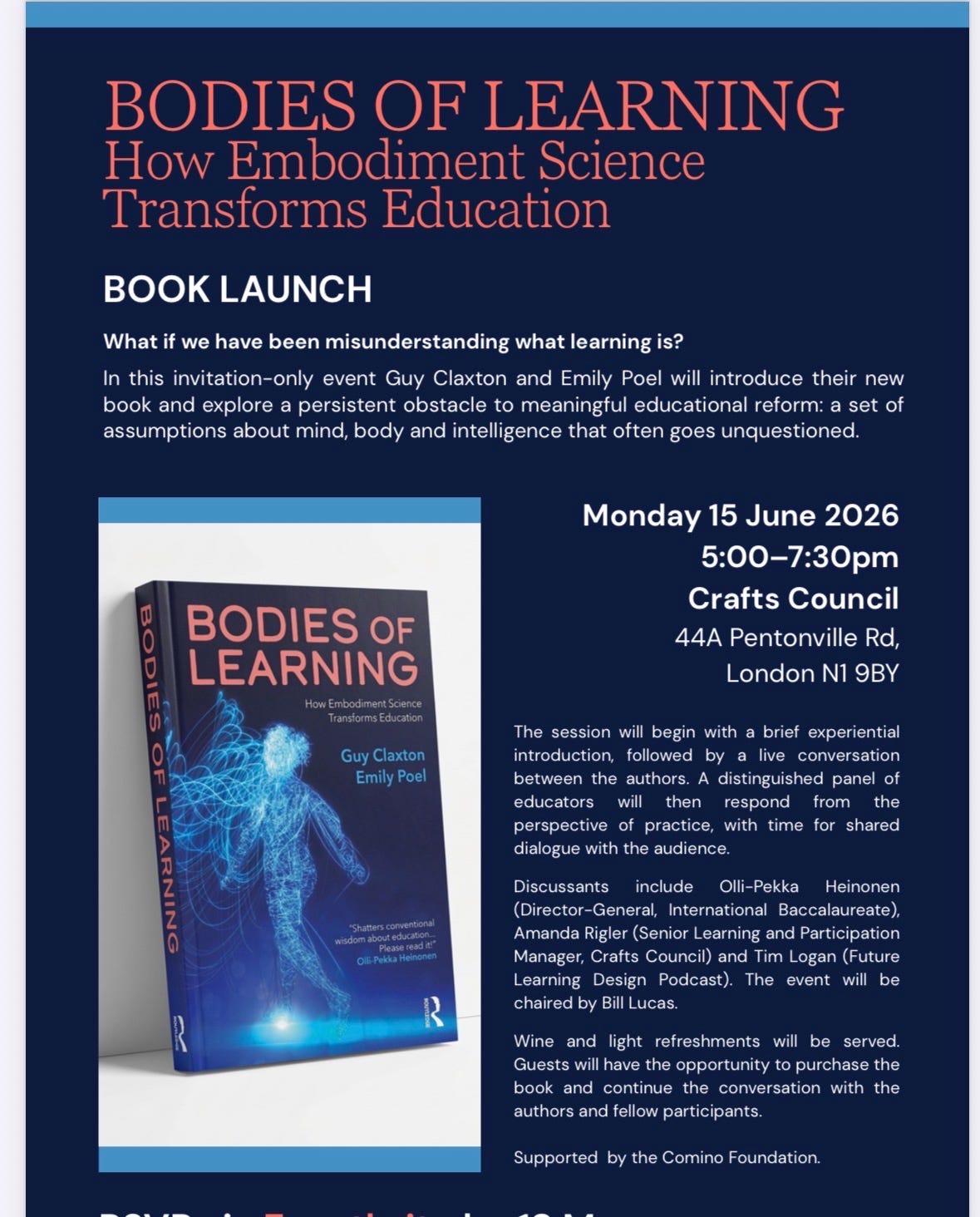
It was great to meet Emily, who has teaching expertise in a range of embodied practices and kept the book grounded in ways it might not otherwise have been - she also got everyone to introduce themselves to each other with their left elbow, which I enjoyed - it was just the right mixture of focal and friendly. And how is your left elbow today?
But I was there mostly for Guy, who was my main PhD supervisor back in the day (c2004-2008) and has been a friend and mentor since then. Guy is a trained psychologist but also a lay Buddhist with a fabulous spiritual hinterland. For instance, in 1981, he published (with Anand Ageha) Wholly Human: Western and Eastern Visions of the Self and Its Perfection. On being asked at the event by Tim Logan if he considered himself the same person as he was then, Guy replied without hesitating: “Yes and No”.
In recent decades, Guy has been a leading voice on the science of learning. He has always been interested in the notion that the mind is not only incidentally but fundamentally and constitutively embodied. In 2014, I invited him to give a lecture at the RSA: On Being Touched, Moved: Why spirituality is really about the body.
I have only read some of Bodies of Learning, and that was an earlier iteration when I was asked for feedback, so I will reserve comment beyond observing that there was a palpable excitement on the panel and in the room on Monday, that a book collating the relevant research was necessary, and that an emphasis on embodiment is timely in the context of AI.
And I liked Guy’s terminology for the need for multiple ways of knowing, thinking, and learning, which he called ‘the epistemic orchestra’. There were jokes about overrelying on brass instruments - a metaphor for academic exam-fodder cognition, when instead we should hear from all the instruments (intuitive, embodied, relational, craft, etc.).
I fully expect the book to be excellent, and I hope to interview Guy and Emily about Bodies of Learning. If/when that happens, I will probably post it on the Perspectiva site (please sign up there if you haven’t already). That will be a chance to get into embodiment in education in more depth. For now, I want to share two personal notes that were elicited by the event, while the spirit (or indeed the body) moves me.
**
Something curious happened on Monday. I have to confess that embodiment, as such, is not really my thing. I am grateful to have (or be?) one of these miracles known as a human body, and I enjoyed learning about embodied cognition, for instance, through Lakoff and Johnson, and Andy Clark. I do not doubt that the body and mind are inextricably linked, and I am sympathetic to the idea that spiritual receptivity of various kinds may depend on the state of our physiology. There are ultimately only distinctions rather than separations between body, mind, and world. We come to know this best - that sense of differentiated oneness - when we are thinking and moving with others on a matter of shared concern. Even so, somehow I do not share Guy and Emily’s passion for the subject - or so I thought…
You never know how other people’s interests will rub off on you. Only at the book launch did I realise that a great deal of Perspectiva’s antidebate methodology, which I have played a leading role in, is grounded in a tacit theory of embodied cognition.
It has taken about five years for the antidebate to find its form, and it is now typically a twenty-person inquiry over about three hours, but we have done it with as many as eighty people. Questions arise from felt senses in the room - which questions feel ‘alive’ - and we represent and deepen the inquiry through movement in various ways, for instance, representing the views of the room with lines of bodies and variations expressed on another axis. We also have a stage we call “taking a stand”, which is quite literally stepping forward and courageously standing for something and asking others to join you in physical proximity. We also encourage reflections on how shifts in the argument feel, and where particular statements arise from or land somatically and intuitively.
Many people have contributed to the creation of the process, and the antidebate has many different forms of supporting theory - I am gradually writing a book about it. But curiously, I hadn’t really noticed until Monday that what we are doing with the antidebate is a kind of applied embodied cognition, and almost certainly indirectly influenced by Guy’s sustained interest in the role of embodiment in understanding psycho-spiritual and learning matters. The point is not just that the body knows things, but that the mind responds to the body feeling and moving. As the statement attributed to Augustine, amongst others, puts it: solvitur ambulando: it is solved by walking (and not just walking, but eating, stretching, breathing, etc)
*
The second thing I can share today is that Guy steered my PhD from a generalised curiosity in the idea of wisdom towards examples of embodied and situated wise action, considered through the lens of enactive cognition, particularly as conceived by Francisco Varela.
Varela puts it like this in a wonderful little book called Ethical Know-How (p4).
As a first approximation, let me say that a wise person is one who knows what is good and spontaneously does it. It is this immediacy of perception and action which we want to examine critically. This approach stands in stark contrast to the usual way of investigating ethical behaviour, which begins by analysing the intentional content of an act and ends by evaluating the rationality of particular moral judgments.
I can’t share the whole thesis, but I became interested in this ‘immediacy of perception and action’, and started looking for examples of it in stories and anecdotes from people’s lives. Part of the work of the thesis was to shift the perspective from ‘a wise person’ to ‘wise action’, in recognition of the situational and embodied context that made such action possible for someone who is, as I put it, disposed to act wisely, or who is ready, willing and able to act wisely in a deft and timely manner. The most prismatic example comes from one of many actions of a person that many would consider ‘wise’ - Mahatma Gandhi.
One of my favourite examples goes like this:
As he hurriedly boarded a train that was beginning to depart, one of Gandhi’s sandals fell on to the track.
He immediately took off his second sandal and threw it close to the one that had fallen, so that later somebody would find them, and have a pair of sandals to wear.

Just as Gandhi probably did not in fact say “be the change you want to see in the world”, it is entirely possible that Gandhi did not ever throw down his second sandal. However, this has become one of those ‘true myths’, where the truth may not be literal or historical, and yet it has earned truthful status because of what it conveys about Gandhi and about wise action.
To assume for the sake of argument that it happened, what I find arresting is the speed with which Gandhi acted. It seems that he immediately reframed the situation from being one of personal loss to someone else’s gain, and was therefore in a position to act effectively. I imagine many might think of the solution, but only several minutes later, when it would have been too late.
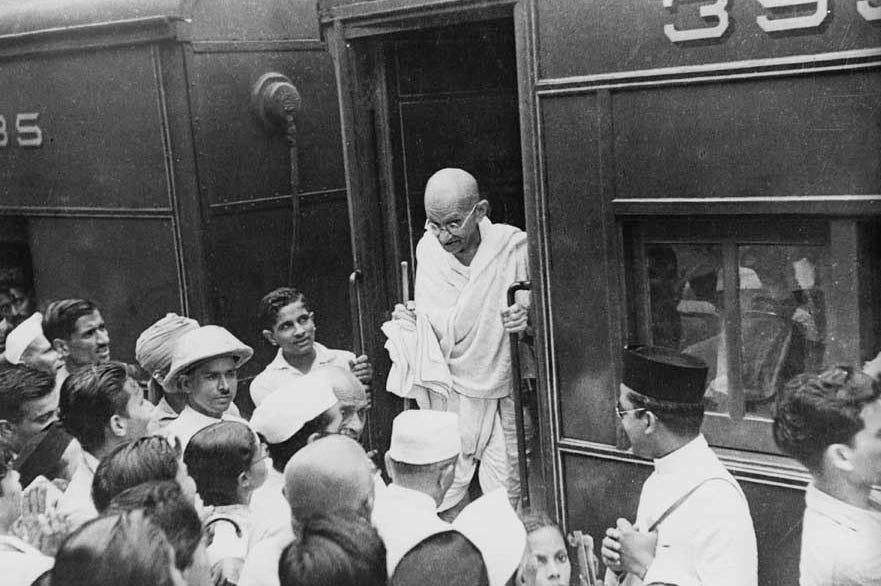

Gandhi was ready, willing, and able to act wisely, and how this kind of disposition emerges was the concern of my thesis. A full discussion of the formation of Gandhi’s character is beyond our scope, but it is noteworthy that when asked, just before his seventieth birthday, to single out the most formative experience of his life, he mentioned a very different but related train story in South Africa (which happened before the putative second sandal story in India).
…One experience that changed the course of my life. Seven days after I had arrived in South Africa the client who had taken me there asked me to go to Pretoria from Durban. It was not an easy journey. On the train I had a first-class ticket, but not a bed ticket. At Maritzburg, when the beds were issued, the guard came and turned me out. The train steamed away leaving me shivering in cold. Now the creative experience comes there. I was afraid for my very life. I entered the dark waiting room. There was a white man in the room. I was afraid of him. What was my duty; I asked myself. Should I go back to India, or should I go forward, with God as my helper and face whatever was in store for me? I decided to stay and suffer. My active non-violence began from that day.
Clearly, the character-forming experience of being thrown off a train is markedly different from the wise act of throwing one’s own sandal off a train, but there is an important link between the two, which is illustrative and suggestive rather than directly causal. The contention is that it was Gandhi’s capacity to repeatedly milk his own experience to reaffirm values, direct motivation, and thereby strengthen dispositions that is salient here. It was through his response to situations such as these that he acquired not only the capacity, but also the readiness and willingness to act spontaneously with his body, when it mattered.
To be able to throw his shoe off the train when he did, Gandhi had to be open to the experience of what was happening, fully present and, as one research participant put it, “highly attuned to his own humanness”. Similarly, when he was thrown off the train, though highly distressed, he saw it as a learning experience and opportunity. In both cases, he was somehow open to what was happening. He did not rush to judgment about what was going on, by lamenting the loss of a sandal or the cold waiting room. In both cases, there was something about his fluid view of himself and his learning capacity that allowed him to optimise the available opportunities. I believe this kind of learning process is central to the concept of wisdom and the task of becoming wiser. We need to become more adept at immersing ourselves in the interpersonal problems we face and examining their intrapersonal basis; and curiously, this kind of reflection sets us up to be more disposed to act wisely when the time comes.
I realise the antidebate and Gandhi’s second sandal are lateral to the main points of emphasis in the new book, Bodies of Learning, but I wanted to illustrate that a book, a book’s history, and a book launch can have extraordinary indirect effects, and that this is a nod to the creative process, and that whoever said the main secret of success is “showing up” was probably right.

“Embodied” is getting to be one of “those” words — nevertheless, these books sound like works that could expand horizons for people both established and new to this field. I hope and trust that they honor their origins in the work of enlightened educators from the last century, though. “Embodied” learning used to be called “kinesthetic” learning back when I was a working teacher, and while I’m sure recently invented ways of measuring have augmented the hard data, it’s not new. Although perhaps it used to be considered more a methodology than an integral part of learning, as in the body learns and knows things that cannot be articulated.
And — the immediacy illustrated by the sandal story and your perceptive commentary harked me back to my long-time teacher Krishnamurti, who described this state of awareness repeatedly, one could even say endlessly, in his talks and writings. No gap between perception and action means no intervening thought, which according to K is the source of all our confusion.
Really enjoyed this! The threshold crossing you describe from ‘wise person’ to ‘wise action’ feels critical and echoes the move from ‘systems thinking’ to ‘systems being’. And the reminder that wisdom is necessarily embodied and relational…and that the task of ‘becoming wiser’ is at its core a learning process....feels timely.
I like how you hold the sandal story – parable perhaps? – as a ‘true myth’. A story that conveys an essential truth without necessarily using literal facts. It feels like the precise inversion of a conspiracy theory – a story that deploys selectively true anecdotes to convey an essential falsehood. The latter offers some kind of seductive felt-sense of enclosure as the world clicks into some kind of order…. uncertainty is definitively banished and we become the knower rather than the learner. But with the Gandhi story…and the post in general… I’m left asking myself more questions…what would I have done? What does it mean to cultivate such a disposition? To move from – and inhabit our web of relationships from - a place of heartful and deeply intelligent spontaneity? To inhabit uncertainty with a little more curiosity...