

A wayward young man sought guidance in a temple on the outskirts of his city. He was weary, tired of pretending that he knew what life was for.
The resident master looked him over. ‘What have you studied?’ he asked.
‘The only thing that ever really captivated me was chess.’
The master fetched his nearby assistant and reminded him of his vows of trust and obedience. He instructed him to fetch a chess set and a sharp sword.
He returned to the young man. ‘You will now play a game of chess with my assistant, and I will behead whoever loses. If chess is really the only thing you feel is worth mentioning, and you can’t beat someone who barely knows the rules, your life is not worth saving.’
On sitting down to play, the young man noticed he was beginning to tremble; the prospect of death brought him to life for the first time in months. Suddenly, something mattered. After a few familiar moves he rediscovered the bliss of concentration and the beauty of ideas, and his superior understanding became obvious.
On realising that he would soon deliver checkmate, he looked up at his opponent. The master’s assistant was so unlike him. On the chessboard he was floundering, but he looked disciplined, dignified, and full of the goodness of life.
The significance of the next few moves would live on in perpetuity, and the young man was no longer sure what he wanted from the game. He maintained his advantage, but started to make small mistakes to keep the game going.
The master noticed this change in perspective and swept the pieces from the board. ‘No one needs to die here today!’ he said. ‘Only two things matter on life’s path: complete concentration and complete compassion. You have learned them both today.’
But the master did not fully convince. The players knew the game might have ended differently. The young man stayed a while in the temple, and the opponents became lifelong friends. It is not known whether they ever played chess again.
This is a revised and adapted version of a Zen teaching story that I share at the beginning of The Moves that Matter: A Chess Grandmaster on the Game of Life. (Bloomsbury 2019).
I use the adapted and revised Zen story above as a prologue to the book, because I believe three main things constitute chess’s cultural significance and longevity, and they are all sublimated through the story.
First, chess is a ritual encounter with death in disguise.
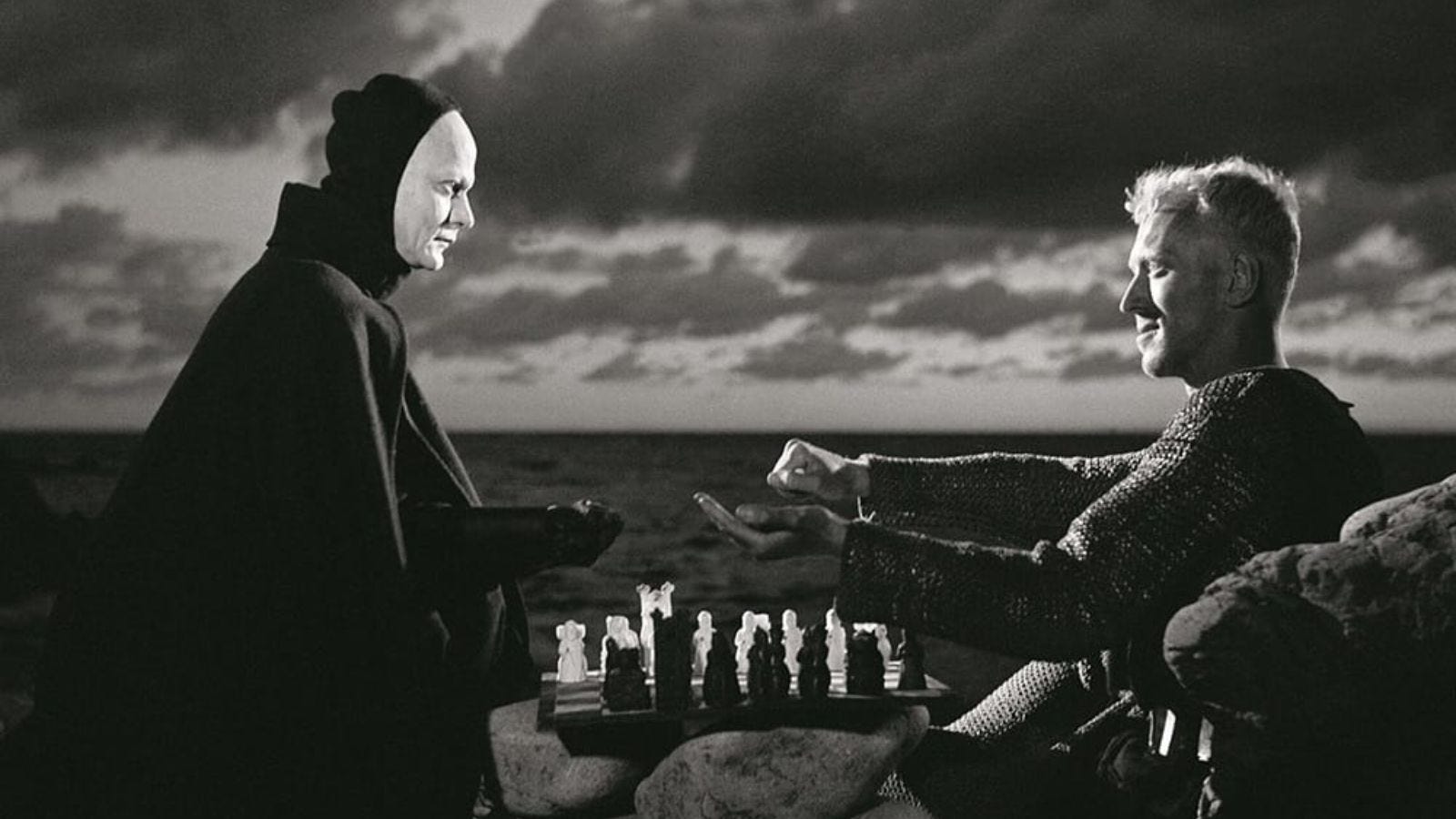
Bergman’s film, The Seventh Seal (above) is the classic cultural expression of this idea, but our encounter with death applies to every game. In the book, I put it like this:
Chess is not the meaning of life, but it does simulate necessary conditions for a life of meaning. Whether through work or love or art, life becomes more meaningful whenever we take responsibility for something or someone. Responsibility is not always pleasurable or even positive, but it is purposeful – it adds significance and direction to life and helps answer the perennial human question: what should I do? And while our lives are characterised by many things, they are defined most profoundly by the open secret of our inevitable deaths. Chess therefore simulates the meaning of life because it is a ritual encounter with death in disguise, where we experience the responsibility to stay alive one move at a time.
The game is sublimated warfare and chess players are compelled to kill, but unlike the gruesome horror of war, the martial conceit of chess allows us to experience aesthetic liberation. Every battle is a unique geometric story where two protagonists seek to destroy each other, but the underlying logic feels beautiful and true. The more intense the battle and the more sublime the ideas, the more we experience power and freedom.
Second, chess is an elaborate pretext for the experience of concentration.
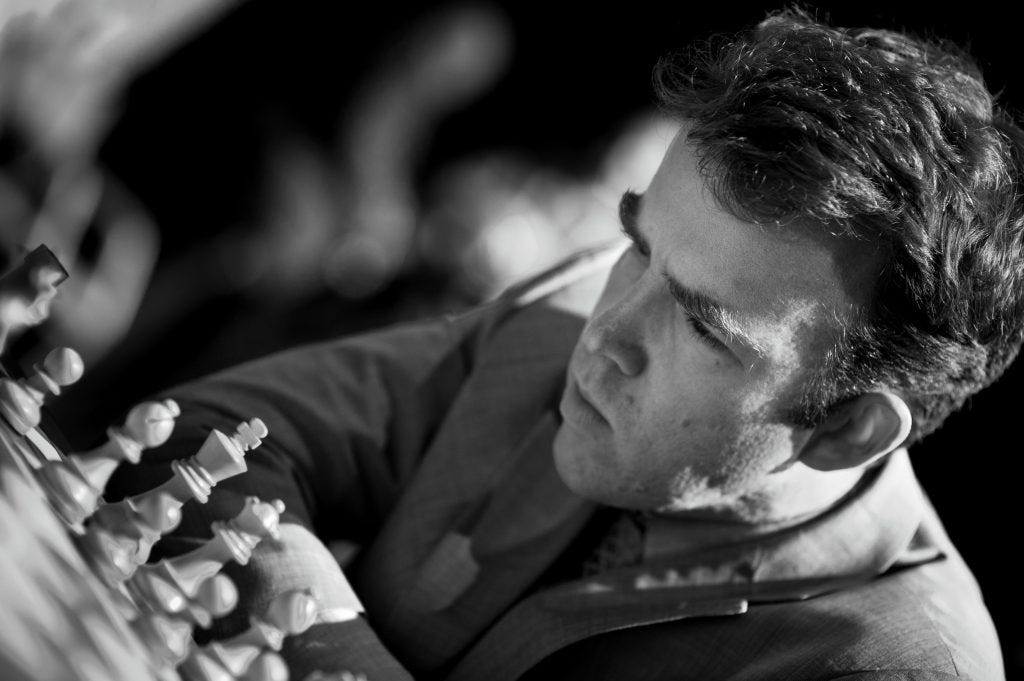
Here is how I describe chess as an affordance for concentration in an essay in Aeon magazine.
…I miss many things about not being an active player. I miss the feeling of strength, power and dignity that comes with making good decisions under pressure. I miss the clarity of purpose experienced at each moment of each game, the lucky escapes from defeat, and the thrill of the chase towards victory. But, most of all, I miss the experience of concentration.
I can still concentrate, of course, but not with the same reliability and intensity that a life of professional chess affords. In fact, from a distance, chess looks to me suspiciously like a socially permissible pretext to concentrate for several hours at a time. In The Island from the Day Before (1994), Umberto Eco composes a love letter that includes the line: ‘Only in your prison does [my heart] enjoy the most sublime of freedoms’ – that could be said of chess, too, and the experience of concentration is what makes it possible. I believe concentration is a defining feature of a fulfilling life, a necessary habit of mind for a viable civilisation, and that chess can teach us more about what concentration really means. Any skilled endeavour entails concentration, but chess is unusual in requiring that we concentrate not for a few minutes at a time, but for several hours at a time, within tournaments, for days at a time, and within careers, for years at a time. Concentration is the sine qua non of the chess experience.
I detail why I see concentration not primarily as a matter of focus but as a matter of coalescence in an essay for my Grandmaster Chess Therapy Substack (which I rarely use at the moment, but hope to develop before long - please sign up!).
Third, chess is the quintessential metaphor that reveals the centrality of metaphor to human experience and cognition.
Chess is just a game in the way that the heart is just a muscle. There is a muscle that pumps blood around the body, but it is the heart that sustains conscious life, signifies love and situates courage. There is a game with sixty-four squares, thirty-two pieces and some rules, but it is chess that has become a metaphor for human battles big and small, an enchanting mirror for the psyche, and a cultural icon for all that is deep and difficult.
The introduction to the book goes into greater depth, but the central idea is this:
Chess is associated with intelligence mostly because the game involves logically working through complex problems, but I have come to believe that the power of chess as a symbol of intelligence also lies elsewhere, in the tacit recognition that metaphors are at the heart of creative intelligence and that chess is a particularly important kind of metaphor. We associate chess with intelligence not just because the game requires us to think several moves ahead, but because its relationship to culture discloses our mind’s relationship to the world.
Intractable political negotiations are regularly described as stalemates, unwitting characters in movies are often described as pawns, and sporting commentators often announce disconcertingly that the tennis or cricket match you thought you were watching is now ‘a chess game’. When I hear chess metaphors like these I feel bemused, not because they don’t work but because they invariably do, and yet we rarely ask why. We think with and through metaphors all the time, but rarely notice we are doing it because our appreciation of metaphor is underdeveloped. We learn about metaphor in school alongside similes and analogies, but metaphor is more than just a way of comparing things. I think of metaphor as the creative device we use more or less consciously to construct meaning through shifts in context, relationship and perspective.
The Moves that Matter was published in 2019, and I haven’t given the book much thought in recent months, but a few things have brought me back to it.
First, there have been a couple of Netflix documentaries about chess. I really enjoyed the one about Judit Polgar. She was in a different class, but we once played in the same elite tournament where I was a wild card (no, really!), and we met at the dinner beforehand. She’s a singular star. More generally, the film was a huge nostalgia trip. I feel extraordinarily lucky to have played chess professionally for so many years, and to have played against so many of the top players shown in the archive footage. It feels like another life, but I am glad to have lived it. However, I was much less keen on Untold: Chess Mates on Netflix, about the Carlsen-Niemann cheating scandal. It has its entertaining moments, but overall, the film amounts to a sensationalised story based on grotesque imagination that was ultimately a matter of character assassination without adequate remorse, in the service of a tech platform that fuelled and benefited from a scandal. I was involved in a few interviews at the time, and there’s one on The Jim Rutt show you might like.
Second, earlier this week, I was invited to Sotheby’s Auction House, to be part of a panel discussing Lothar Schmid’s extraordinary chess library called Chess, Culture, and the Cold War. I have things to say about the cultural evolution of chess, but I had forgotten most of them, so I listened to excerpts from the audiobook to jog my memory. I commented on the image below, known as The Devil’s Checkmate or Die Schachspieler (The Chess Players), by Friedrich Moritz August Retzsch (1779–1857), which was part of the exhibition.
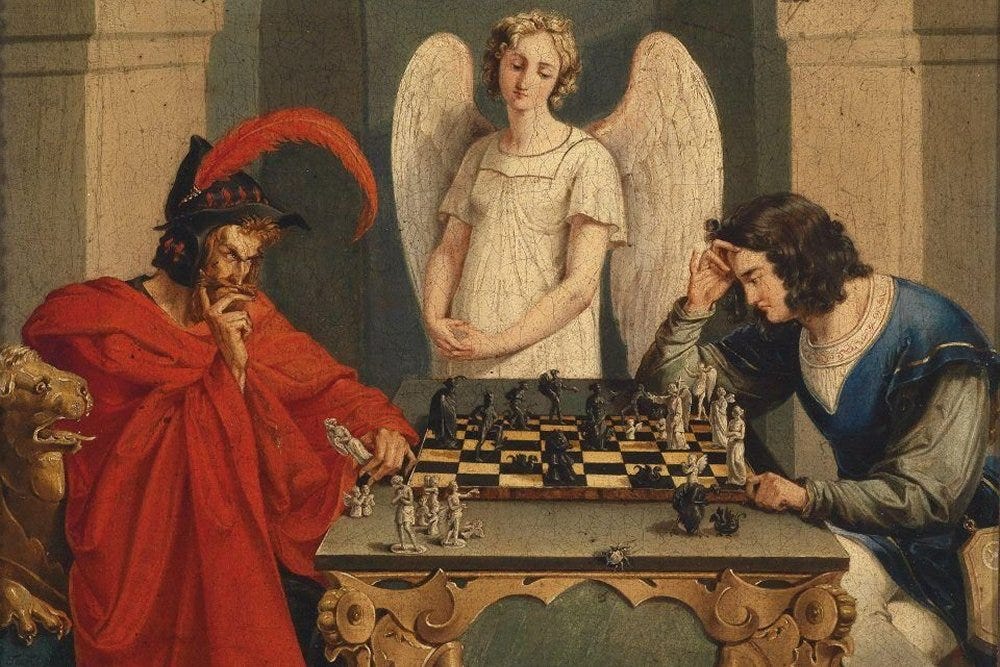
It’s all there somehow. The position is barely legible as a position, that’s not a real devil, and the angel looks a bit bored, but the notion that something existential is afoot, that we are in metaphorical terrain, and that the fate of the soul is in play, very much rings true.
Third, an invitation to play in the British Chess Championship popped into my inbox. It’s exactly twenty years since I last won the event, and I confess I am ever so slightly tempted to rediscover my love for the game. “Don’t do it! It’s just a midlife crisis”, says one voice. But the other says: “Go for it! This is exactly the sort of thing that midlife crises are for.” We’ll see…
Fourth, today is my birthday. Not yet a huge one, but very close now, so naturally I am looking backwards and forwards. The 48-49 year has not been the easiest, but the sun is shining, the heart is beating, and there are many more moves to make that matter.
My grandson learned to play chess from an old man who lives next door and gave him a book on chess strategy, and he loves the game—joined the chess club at school. He’s only 11 but someday he will be ready for seeing chess at this deep level. Thank you, and happy birthday—I hope you’ll play again.
FWIW, I am feeling a call to play drums again ... I definitely think you should enter that tournament.
[Although I certainly don't have any sort of 'previous winner at drums' target on my back, so I can also see how it's not quite the same 🤣].
And a belated happy birthday to you!