

If you haven’t read Make Something Heavy by Anu I can strongly recommend it. It’s a reflection on the internet’s demand for content, leading creators of all kinds to churn out things that are relatively brisk, appealing and scrollable, in other words: light.
Anu is not against lightness, and, impressively, she resists the temptation to refer to Milan Kundera’s Unbearable Lightness of Being. But she notes that while lightness is creating culture at the moment, it rarely creates us. The things that forge the soul tend to be heavy. We associate heaviness with the effort of lifting, with meaning, mattering, and significance. Anu says:
Heavy projects are the lifeblood of creative fulfillment — and creative longevity. And for now, no platform truly offers that kind of weight on its own. Platforms are built to amplify, not anchor.
I love writing here, I am grateful for all your support, and I am not going anywhere, but after reading Anu’s piece, I noticed I have been producing material that is relatively light for a while now. My writing is not typically light in the frivolous or evanescent sense, but it is written to process, communicate and learn. I ‘post’ (a strange word if you think about it) as a kind of work, but it is also fun, and it’s an escape and even a relief for me; a kind of safe space, even. I know what I am doing here, churning out words, and it’s a valued practice. However, I have earned, created or co-created quite a few ‘heavy’ things over the years - degrees, titles, books, marriage, family, projects, institutions, festivals, homes, practices, and I know the difference. It has also been a while since I made anything heavy.
I have two major projects at work that are at least proto-heavy, and I am looking forward to lifting them into shape. And I have three major writing tasks ahead that have nothing to do with Substack. One of them is developing a new conceptual idea for a journal by invitation, one is an open letter to a Lough that appears to be dying, and one is a short book about an experimental social practice (and I can also feel another book in utero). These tasks are all heavy in a good way. If I get them right, they will endure and have a lasting influence, so I need to turn my writing energy towards them and make them my priority.
What I can still do here, lightly, is share my ongoing joy at existence, one anecdote and reference at a time.
For instance, yesterday, I had a good catch-up chat with an old friend of about thirty years. We met near Notting Hill Gate tube station in between other weekend adventures. We had time for one beer, but he took coffee because he was about to go to work nearby as a chess tutor. Most of the conversation was downloading and listening, but one part stood out.
This friend is also a chess grandmaster, a few years younger, a bit stronger, and also a father in the thick of family life. We know each other’s war stories. Both of us are (probably!) past our prime as players, and neither of us plays much, but we both noted that in recent months, and perhaps because of the chess boom, lots of people, including our nearest and dearest, have been telling us to play more. There are not many grandmasters - it was about a thousand when I became one in 1999, and it has doubled since - and very few of us are retired or semi-retired, so my friend is one of the very few people in the whole world who can understand how this suggestion feels.
We looked at each other and laughed about it. In fact, we laughed big belly laughs about how little the people making this suggestion know what it means.
We laughed about the absurdity of studying opening theory in your forties, about caring about whether to play the Najdorf or the French, and the highly non-trivial challenge of caring enough to mobilise proper competitive energy.
I remembered a quotation I used to have on my wall as a child by the US Basketball Coach, Bobby Knight: “The will to win is not as important as the will to prepare to win.”
We can both show up and compete at a high level, but waking up to study chess when you have other work to do, and have to make breakfast for the kids, does not just feel difficult, it feels incongruous and absurd. To lose the will to prepare to win is to lose that connection with heaviness, to forsake and tacitly disavow the responsibility to hone yourself for your craft so that when the challenge comes, you are ready in mind, body, and soul.
I admit I miss chess and often think about returning to it in some way, but the idea of re-entering the fray as a competitor with a will to prepare to win - and why? - to climb some of the ranks I’ve slipped down? That feels like another me and another life; one I have known and loved to be sure, but it is a skin I shed a long time ago.
You might think we can play just for the fun of it, but when you have known chess at the highest levels, your sense of ‘fun’ is closely tied to the experience of excellence.
As the laughter subsided, I found the words I had been looking for over many years.
“What they don’t realise they are asking for,” I said, “is intensity. To ask us to recommit to chess at a grandmaster level is to ask us to commit to intensity.”
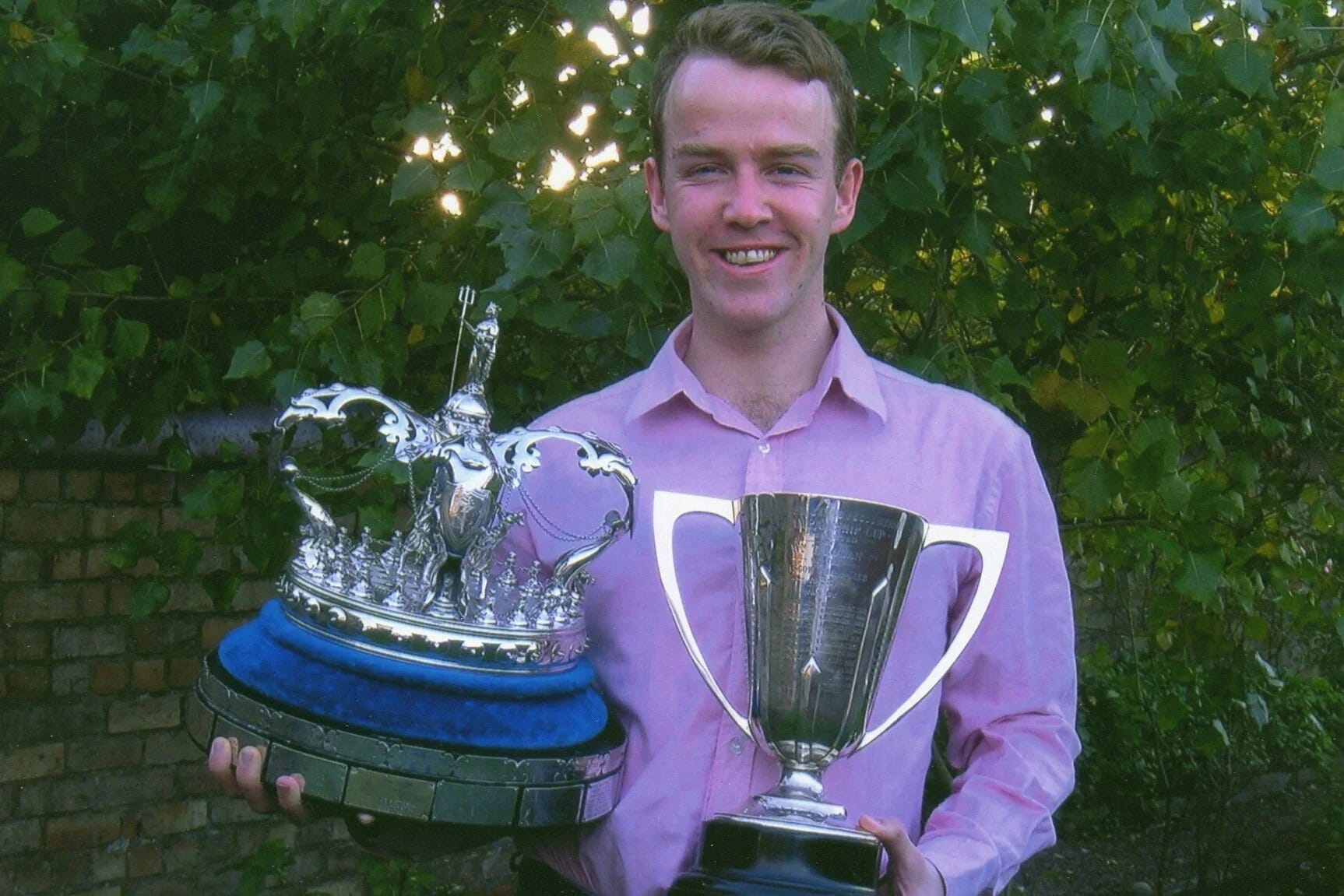
Here are three photos. The first photograph is of a younger me, about nineteen, when chess was the centre of my world, and I clearly took myself and my work very seriously.

The second photo is of me at twenty-seven, when it looks like I had opened out to the world a bit, but still took the game very seriously. I won the Scottish and British Championship in that same year (2004).
The third photo is of me at about forty-five, in the garden of my former home, where I think you can sense some ambient irony, and that I find the notion of posing with a chessboard and fire amusing.
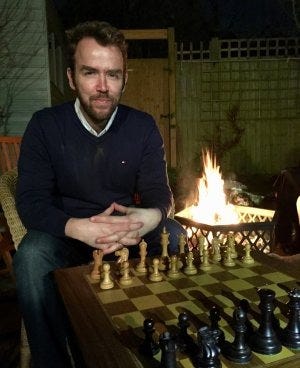
I still strive and struggle in other ways, and I have many remaining ambitions, but life is relatively mellow now, and I like it that way.
For good and bad, nothing compares to the competitive and intellectual intensity of chess, which anthropologist Robert Desjarlais once described as “a swirl of deeply felt intensities.” The contrast between otherwise ‘normal’ life and a life of chess ambition is profound. To leave behind chess ambition is like leaving a relationship, and one that is not easy to rejoin. In The Moves that Matter (2019), I wrote this:
For about half of my childhood chess was central to my idea of who I was, but also what the world was about, and for. I loved the game with all the pain, need and longing that is wrapped up in love. I have loved chess as a child loves a guardian who keeps them safe, as a teenage boy loves a girl who represents love itself, as a young adult loves his newfound autonomy and his place in the community, as a student loves his teacher, as a friend loves his friend, and as a father loves a child. I am no longer sure exactly how I love chess, but it is in all these ways and more.
Thinking back to yesterday, I suspect we laughed so loudly because we have such a visceral sense of why it’s not just a game for us. We both put in many thousands of hours at the chessboard and know exactly what it feels like to sit there for hours as the battle unfolds. The tacit knowledge is mostly ineffable, but there’s a lot of it. Our identities and nervous systems have been forged by those fires, and we are grateful for it. When friends, family and fans of various kinds ask us to go back there and “play again”, this is, on the one hand, encouraging and touching; it’s as if they are saying they see and love the child in you and want it to come out again.
But they don’t really know how hard it is to prepare, how it feels to blunder, or to find yourself lost just out of the opening, or struggle to convert an advantage in time trouble. They don’t know about defending a rook endgame, a pawn down for many hours before resigning, all because you blundered from a winning position. They don’t know the energy it takes to create your luck at the board, and the confidence trick required to pull that off. They don’t know how the nervous system feels when you allow it to invest and continuously reinvest in winning at a game that asks so much of your body, mind, and soul.
So I am very grateful to my friend for yesterday’s moment of laughter and solidarity.
Somewhere in the gospels it says: “Forgive them, for they know not what they do”.
People asking inactive chess grandmasters to play more do not know what they ask!
Thanks for this one, Jonathan, both for the glimpse it gives of a particular world and for a thought it spurred. An important teacher of mine from my late twenties, a man who I recognise now held the vital "older brother" role, being about five years ahead of me, taught me to question my youthful centering of intensity. This was primarily intensity of feeling, and I'd have to think further about how that relates to the intensity you are writing about here. But the lesson he taught me was to recognise that, contrary to an assumption I had absorbed in adolescence, there is no necessary connection between intensity and authenticity. Indeed, in the domain of feelings, not only does my intensity of feeling not make the experience I'm having "more real", it also increases the likelihood that I am oblivious to what anyone else involved in the situation may be feeling. So the louder my feelings, the more likely it is that something will go astray between us. That lesson was, for me, the beginning of learning how to move beyond being young, and the seed from which the kind of middle-aged laughter I seem to hear in the background of your piece would become possible, a laughter which, at its best, is grounded in the kindness of experience.
Thanks for the Anu book suggestion.
And…I was one who (Blithely!) encouraged you to get back to playing chess. Right, I had no idea.